



Tell the organizers: placing GCS in Singapore isn't because it's the 'gateway to Southeast Asia,' but because it's the 'global crossroads.'
 ice
•
ice
•
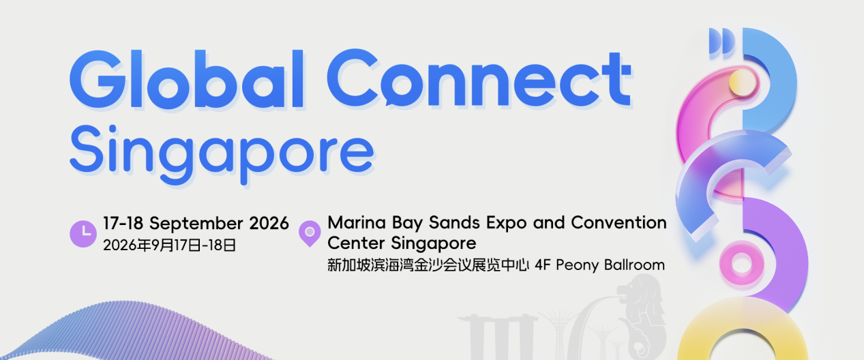
September 17–18, 2026 – Global Connect Singapore will be held at Marina Bay Sands Convention Centre in Singapore. Four thematic summits – the Global Growth Summit, the AI+ Application Summit, the AI Technology Development Summit, and the Software Globalization Summit & AI Project Roadshow – will take place over two days, expected to attract over 1,500 industry attendees, with more than 60% holding senior executive positions, covering over 30 countries and regions worldwide.
As the Founder and CEO of Baijing Chuhai, Bandari Wei has been deeply engaged in the globalization field for eleven years. From starting with a single QQ group in 2014 to now bringing the summit to Singapore, his observations may answer one core question: Why Singapore?
Below is his response.
Part One: Rethinking Singapore – More Than Just a Gateway to Southeast Asia
Q: Many people, when they think of Singapore, immediately think "Gateway to Southeast Asia." But you don't seem to see it that way?
Bandari Wei: Indeed, I don't. The Southeast Asian gateway is just one facet of Singapore. But if you only see it as a "springboard into Southeast Asia," you underestimate Singapore's true value.
I often tell my team one thing: Singapore is not just the gateway to Southeast Asia; it is the proving ground that tests whether a company truly has a "global gene." What does that mean? Before coming to Singapore, you might think you already have a strong global mindset. But once you're here, facing companies from over 30 countries, the regional headquarters of more than 4,000 multinationals, and completely different business rules and competitive density – you truly realise that globalisation is not simply translating Chinese products into a foreign language.
Q: How would you define Singapore's position on the global map?
Bandari Wei: The global crossroads. Not regional – global.
Just look at the data. Changi Airport currently connects to about 170 cities worldwide, and Singapore aims to expand its route network to over 200 cities by the mid2030s. What does 170 cities mean? From Singapore, a sixhour flight covers half the world's population – China, India, ASEAN, Australia, the Middle East – all within reach. This is not a Southeast Asian hub; this is a global hub.
Q: Changi Airport connects to 170 cities globally, and the Port of Singapore has been ranked the world's top shipping centre for 13 consecutive years, connecting over 600 ports – what do these "global connectivity" advantages mean for businesses?
Bandari Wei: It means your clients, your partners, and your competitors are all under one roof.
The Port of Singapore has been named the world's best international shipping centre for 13 years in a row, retaining the top spot with a score of 99.32 in 2026. But a port is not just for cargo – it is a barometer of commercial flow. The arteries of global trade pass through here, and so do capital, information, and talent.
For businesses, this means you don't need to fly around the world to meet people. You fly to Singapore, and you meet people from all over the world. That's not just "convenience" – that's "efficiency." For business decisionmakers for whom time is money, this efficiency itself is a competitive advantage.
Part Two: Policy Dividends – The "Global Pass" from 29 Free Trade Agreements
Q: Singapore has signed and implemented 29 free trade agreements, covering major markets in Asia, Europe, and the Americas. For participating companies, is this "icing on the cake" or "fuel in the snow"?
Bandari Wei: Fuel in the snow.
Many people think FTAs are something only large corporations can use – but in fact, the opposite is true. For companies that are globalising, FTAs can be the key factor that determines whether you can gain a foothold in a given market.
Singapore has signed and implemented 29 FTAs. Singaporean exporters and investors enjoy tariff reductions, preferential market access, expedited customs clearance, and intellectual property protection, among other benefits. Take RCEP – it covers 15 member countries, with approximately 92% of goods enjoying tariff reductions. The ChinaSingapore FTA has eliminated tariffs on 95% of Singapore's exports to China.
But honestly, the vast majority of companies don't even know these policies exist, let alone how to use them. One of the purposes of holding GCS is to ensure that attendees not only "know there are dividends," but also "know how to use them."
Q: Many companies know FTAs exist but don't know how to use them. Can GCS help them solve this problem?
Bandari Wei: Yes. But not by handing out a policy manual.
Our approach is to bring people together. The dividends of 29 FTAs are not written on paper – they are realised through collaboration between people. You meet a buyer from Europe in the exhibition zone, you have a good conversation, and then you discover that because Singapore and the EU have an FTA, your product can enjoy tariff reductions when entering the European market – at that point, the FTA is no longer an abstract policy, it's an actual clause in your contract.
So at GCS, we don't treat FTAs as a "topic" to be discussed; we treat them as a "backdrop" to be used. You come, you chat, you negotiate – and the dividends naturally emerge.
Part Three: From GTC to GCS – A Strategic Upgrade
Q: The GTC Global Traffic Conference already has a strong reputation in China. Why set up a new event in Singapore?
Bandari Wei: It's not starting from scratch – it's a strategic upgrade.
We have run the GTC Global Traffic Conference for many years. From its inaugural edition in 2018 to now, we have successfully held over ten editions, gradually growing it into one of the largest and most comprehensive industry events in China's crossborder sector. At GTC2026 in Shenzhen, over 25,000 professional visitors attended over two days, with total participation exceeding 48,000, nearly 170 exhibitors, and over 100 speakers. GTC's positioning is very clear – it is a "traffic hub" for resource connections, solving the problem of "finding resources, channels, and clients."
But by 2026, the challenges facing companies have changed. In the past, the concern was "how to go out"; now it's "how to stand firm globally." This is not a problem that traffic can solve – it requires strategic understanding, deep connections, and localisation capabilities.
So GCS is positioned as a "decision arena" – it's not about exchanging business cards, but about exchanging judgments. It's not about finding traffic, but about finding direction.
Q: If GTC is like an "annual gathering for globalisation practitioners," what is GCS more like?
Bandari Wei: A "strategy meeting" for globalising companies.
A gathering is casual; a strategy meeting is serious. At GCS, you're not there to listen to others tell stories – you're there to judge alongside peers: what will happen in global markets over the next three to five years? How should my company respond?
That's also why we chose Singapore as the venue. When you host an event in China, you face globalisation from a singlemarket perspective; when you host it in Singapore, you face a truly global perspective. People on stage come from different countries, and so do those in the audience. This shift in perspective is more valuable than any single presentation.
Q: Will GTC and GCS coexist in the future, or will they have different roles?
Bandari Wei: They will coexist with different roles. GTC will continue to deepen the "traffic" and "resources" dimension, while GCS will deepen the "strategy" and "insight" dimension.
One in China, one in Singapore; one addresses "how to survive," the other addresses "how to win."
Part Four: Singapore in September – A Focused Realisation of "Global Resources"
Q: With regional headquarters of over 4,000 multinationals in Singapore – how does GCS help attendees "access" these resources?
Bandari Wei: By "being in the same space."
More than 4,000 multinationals have regional headquarters in Singapore, and onethird of Fortune 500 companies choose to locate their Asian headquarters here. This is not a list of "companies you can go visit" – it is a space where "you are already among them."
What GCS does is simple: it focuses the attention of all these people into the same place, over the same two days. You don't need to specifically arrange to meet someone – you just need to show up at the venue. Those speaking on stage are them, those sitting in the audience are them, and those walking through the exhibition area are them as well.
True resource connection is never "I need to go see someone," but rather "we just happen to be here together."
Q: Finally, in one sentence – what kind of person should most definitely come to GCS in September?
Bandari Wei: Someone who is making globalisation decisions.
Not someone who is "just looking," but someone who is "making decisions" – deciding whether to enter a new market, deciding whether to partner with a certain company, deciding which direction the company's nextphase globalisation strategy should take.
September 17–18, 2026 – Marina Bay Sands Convention Centre, Singapore.
Two days, four summits, over 30 frontline entrepreneurs, investors, and technical experts on stage. Attendees come from more than 30 countries and regions, with over 60% in senior executive roles. Industries covered include AI, gaming, apps, crossborder ecommerce, shortform dramas, and investment.
Apply for an invitation ticket (reviewbased) or purchase your pass to secure your seat.

【本篇文章属于白鲸出海原创,如需转载:需联系授权方可,未经授权严转载!】
友情提醒:白鲸出海目前仅有微信群与QQ群,并无在Telegram等其他社交软件创建群,请白鲸的广大用户、合作伙伴警惕他人冒充我们,向您索要费用、骗取钱财!



扫一扫 在手机阅读、分享本文

扫一扫 在手机阅读、分享本文










 闽公网安备35010402350923号