



Singapore is becoming the “default option” for AI globalization.
 ice
•
ice
•
On May 20, 2026, the Singapore government announced three things on the same day: signing an AI cooperation agreement with OpenAI, launching AI cooperation with NVIDIA, and deepening AI strategic collaboration with Google. Three agreements in one day. This is not a coincidence; it is a signal.
Less than two months later, the data confirmed it all.
In July of the same year, Singapore’s non-oil domestic exports (NODX) grew 20.7% year on year, the 10th consecutive month of positive growth. Electronics exports surged 105.1% year on year, the largest increase in 28 years since 1998. Disk media products soared 170.9%, integrated circuits grew 115.4%, and personal computers grew 95.8%—the common name for these categories is “AI computing infrastructure.”
More than 70% of export growth was driven by AI-related electronics. In 2024, that figure was only 46%.
In one year, AI went from “important driver” to “absolute dominant force.”
I. When “Neutrality” Becomes a Strategic Asset
The underlying logic of the global AI race is changing.
Over the past three years, countries competed on model parameters, computing scale, and funding. But by 2026, the core question facing the industry has changed: AI technology needs large-scale deployment, and deployment needs a “safe place.”
Data sovereignty, cross-border flows, compliance reviews, intellectual property protection—these “old problems” have taken on new urgency in the AI era. Companies need a place with political stability, legal transparency, and no sudden rule changes to host AI R&D, data training, and commercial deployment.
Singapore happens to sit exactly in that position.
It is not a party to great-power rivalry and does not choose sides. It has a common law legal tradition, a transparent regulatory framework, and a world-leading intellectual property protection system. In January 2026, it released the world’s first governance framework for Agentic AI—not waiting for problems to erupt before legislating, but writing the rules clearly before the technology matures.
For a company deploying AI products globally, “clear rules” are more important than “loose rules.”
II. Policy Is Not “Encouraging” AI, It Is “Subsidizing” AI
In February 2026, Singapore Prime Minister and Finance Minister Lawrence Wong delivered the budget statement in Parliament, announcing the establishment of a “National AI Council” chaired personally by the Prime Minister.
This is not an advisory body. It is a strategic decision-making body directly led by the highest administrative official.
In January 2026, Singapore announced it would invest more than S$1 billion from 2025 to 2030 to advance the National AI Research Programme (NAIRD), doubling research funding compared with the previous cycle.
By May, Singapore had updated its National AI Strategy 2.0, proposing four national-level AI missions and taking the lead in driving AI transformation in four key areas: advanced manufacturing, connectivity, finance, and healthcare—together accounting for more than 40% of Singapore’s GDP.
Even more direct is the money.
The 2026 budget stipulates that in the 2027 and 2028 tax years, companies’ spending on AI compliance activities, up to S$50,000, can enjoy a 400% corporate income tax deduction.
A 400% tax deduction. That means for every S$1 you spend on AI, you can deduct S$4 before tax.
Singapore now has more than 60 AI Centres of Excellence. The new “National AI Impact Programme” will help up to 10,000 workers become “AI bilingual talent”—able to understand business and also harness AI.
III. Giants Are Not “Investing” in Singapore, They Are “Camping” in Singapore
On May 20, 2026, OpenAI committed more than S$300 million to establish its first Applied AI Lab outside the United States in Singapore.
On the same day, NVIDIA announced expanded AI cooperation with the Singapore government. Google also signed an AI cooperation agreement.
These three giants “planted their flags” in Singapore on the same day. Market analysis notes that Singapore’s political neutrality, combined with massive fiscal subsidies and advanced digital infrastructure, is rapidly making it the most core strategic foothold outside the United States for the world’s top tech giants.
Before that, AWS had announced it would invest S$12 billion in Singapore cloud infrastructure between 2024 and 2028. Microsoft planned to invest US$5.5 billion between 2025 and 2029 in Singapore’s cloud computing and AI infrastructure. Google and NVIDIA also announced AI cooperation with the Singapore government during the same period.
By August, Anthropic, Macquarie Asset Management, and Singapore sovereign wealth fund GIC announced a strategic partnership to jointly establish a platform to develop and operate AI data centers. Data center operator DayOne obtained a US$410 million green loan jointly provided by three major banks to build Singapore’s first data center.
These are not “memorandums of cooperation.” They are implemented projects, construction in progress, and actual hiring.
IV. Singapore Is Answering a Key Question: What Kind of Hub Does AI Globalization Need?
Looking back at the facts above, a clear logic chain can be distilled:
First, geographically, Changi Airport connects about 170 cities worldwide and can cover half the world’s population within six hours. The Port of Singapore has been ranked the world’s best international shipping centre for 13 consecutive years.
Second, in terms of rules, Singapore is one of the few economies in the world that is “ahead of the technology” in AI regulatory frameworks. While other countries are still discussing “whether to regulate,” Singapore has already introduced an actionable governance framework.
Third, in terms of cost, the 400% tax deduction is not a “subsidy”—subsidies go to specific companies, while tax deductions go to all companies. This means any company conducting AI business in Singapore can enjoy the same policy benefits.
Fourth, in terms of ecosystem, OpenAI, NVIDIA, Google, Microsoft, AWS—the most important names in the global AI industry chain—have all established substantive operations in Singapore. This is not a list of places you “can visit,” but a venue where “you are already among them.”
When a place simultaneously possesses the four conditions of “neutrality, clear rules, cost advantages, and a complete ecosystem,” it is no longer an “option”—it becomes the “default option.”
V. This Summit Lands Right at This Inflection Point
On September 17–18, 2026, Global Connect Singapore will be held at the Peony Ballroom, Level 4, Marina Bay Sands Expo and Convention Centre, Singapore.
The event features four major themed tracks: the Global Growth Summit, AI+ Application Summit, AI Technology Development Summit, and Software Globalization Summit & AI Project Roadshow.
Many pain points in going global? Click here to solve them.

The Global Growth Summit focuses on the globalization ecosystem, compliance governance, and localized operations. Global business leaders gather to jointly address cultural differences and policy pain points and promote an open, collaborative global business ecosystem. Confirmed speakers include:
Wei Fangdan — Founder and CEO of Beluga Global
Andrew Phua — Chief Representative and Executive Director, Greater China, Singapore Tourism Board
Deng Xin — Assistant Dean, Nanyang Business School, Nanyang Technological University
James Tan — Managing Partner, Quest Ventures
Huang Peihua — Managing Partner, ACV Capital
Elle Liu — Country Manager for Singapore & Malaysia and Head of Strategic Partnerships for Southeast Asia, Canva
Liu Weijie — CTO, Singapore AI Association
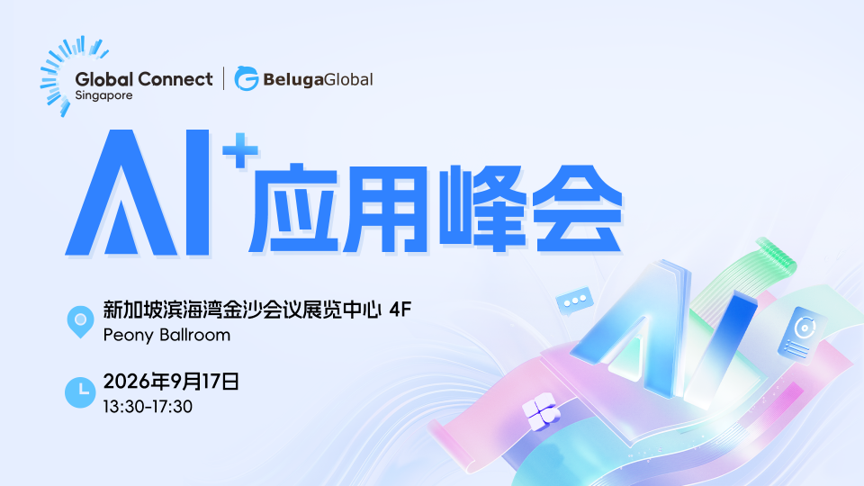
The AI+ Application Summit focuses on innovative scenarios and practical challenges in AI applications. Confirmed speakers include:
Du Jun — Chairman & Founder of WIDTH
Yang Tong — CEO of Agnes AI
Gao Yi — CEO of Arros AI
Steve — Co-founder of SoTALab
Felix Wong — Co-founder & CPO of Emoka
David Wang — VP of Global Distribution, FizzDragon
Yin Lu — Founder of AI SpaceHub
Bintang Hidayanto — Founder of GANI.AI
Mao Hua — CEO of 2nd Brain
Matthias Hendrichs — General Manager, Pit Asia-Pacific

The AI Technology Development Summit is designed for CTOs and technical leads. Confirmed speakers include:
Zhang Xiao — Founder of zCloak.AI
Xu Wen — CEO of OPENVERSE
Hu Chengchen — CEO of ClariPpi
Queenie Wu — Founder of vibethon.ai
Zhao Xiaochun — Co-founder of SmallWOD
Mahendra Swarup — Founder of VG Capital
Weng Wei — Former CTO of OlaChat
Wang Xiaoyu — Founder and CEO of Kelu Network
Li Difu — Co-founder of Video Rebirth
Shao Jianliang — Chairman of ABGA

The Software Globalization Summit & AI Project Roadshow focuses on the globalization path of SaaS and software products, with an AI project roadshow after the roundtable. Confirmed speakers include:
Qian Jinkai — Co-founder and CEO of Linkloud
Duan Jiang — CEO of Fotor
Yang Ling — Founder and CEO of ShipLinker
Leonie Xu — Co-founder of SmallWOD
Cai Li — Co-founder and CEO of DataRaccoon
Wu Wenwei — Partner, Crystalline Network PTE LTD
The summit site also features a brand exhibition area, providing exhibitors with opportunities to meet face-to-face with corporate decision-makers from Singapore, China, and around the world.
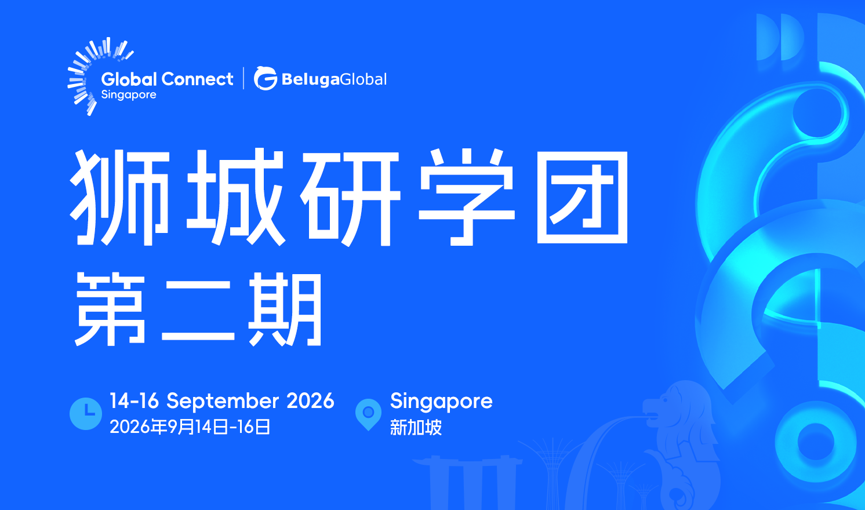
The second Lion City Study Tour, from September 14 to 16, will be led by Wei Fangdan, Founder of Beluga Global, and Leon, Founder of Halo Tech Media, with in-depth visits to leading local Singapore enterprises and institutions.
Finally
The audience comes from more than 30 countries and regions worldwide, with executives accounting for over 60%.
This is not about listening to others tell stories—it is about judging together with peers: What will happen in the global AI market over the next three to five years? How should your company respond?
September 17–18, 2026, Peony Ballroom, Level 4, Marina Bay Sands Expo and Convention Centre, Singapore.
Purchase a ticket or apply for an invitation ticket (approval-based) to secure your seat.

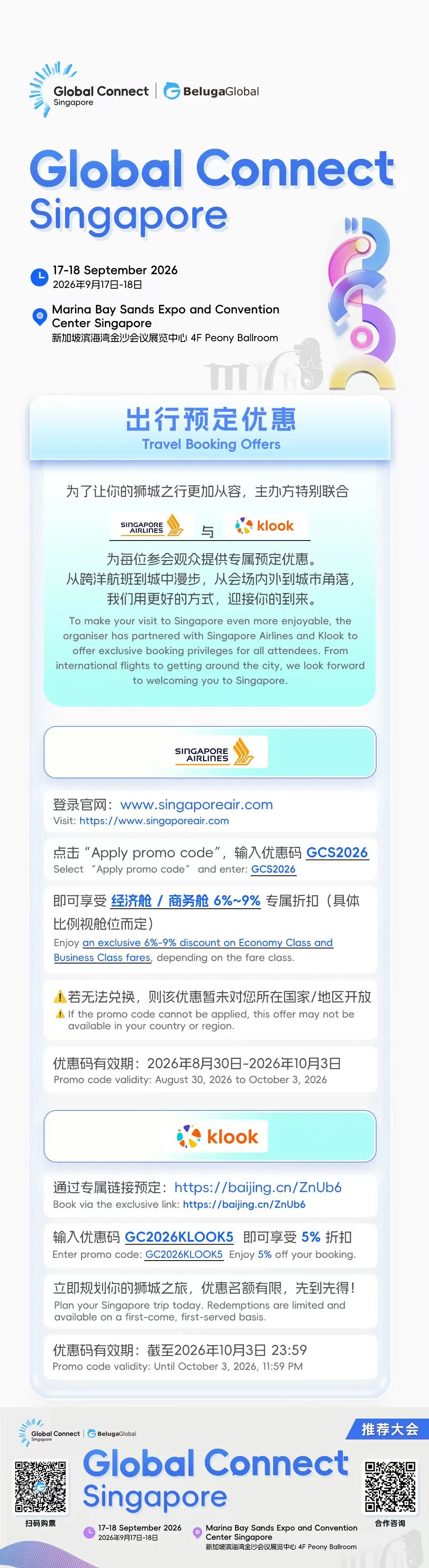
Travel Booking Discounts: Make Your Lion City Trip More Relaxed
To make your Lion City trip more relaxed, the organizer has partnered with Singapore Airlines and Klook to provide exclusive booking discounts for every attendee. From transoceanic flights to city strolls, from inside and outside the venue to every corner of the city, we welcome your arrival in a better way.
GCS Travel Booking Discounts

【本篇文章属于白鲸出海原创,如需转载:需联系授权方可,未经授权严转载!】
友情提醒:白鲸出海目前仅有微信群与QQ群,并无在Telegram等其他社交软件创建群,请白鲸的广大用户、合作伙伴警惕他人冒充我们,向您索要费用、骗取钱财!



扫一扫 在手机阅读、分享本文

扫一扫 在手机阅读、分享本文










 闽公网安备35010402350923号